Electromechanical Coupling Factor
The electromechanical coupling factor, k, is an indicator of the effectiveness with which a piezoelectric material converts electrical energy into mechanical energy, or converts mechanical energy into electrical energy. The first subscript to k denotes the direction along which the electrodes are applied; the second denotes the direction along which the mechanical energy is applied, or developed.
k values quoted in ceramic suppliers’ specifications typically are theoretical maximum values. At low input frequencies, a typical piezoelectric ceramic can convert 30 – 75% of the energy delivered to it in one form into the other form, depending on the formulation of the ceramic and the directions of the forces involved.
A high k usually is desirable for efficient energy conversion, but k does not account for dielectric losses or mechanical losses, nor for recovery of unconverted energy. The accurate measure of efficiency is the ratio of converted, useable energy delivered by the piezoelectric element to the total energy taken up by the element. By this measure, piezoelectric technology in well designed systems can exhibit efficiencies that exceed 90%.
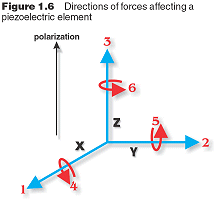
The dimensions of a ceramic element can dictate unique expressions of k. For a thin disc of piezoelectric ceramic the planar coupling factor, kp , expresses radial coupling – the coupling between an electric field parallel to the direction in which the ceramic element is polarized (direction 3) and mechanical effects that produce radial vibrations, relative to the direction of polarization (direction 1 and direction 2). For a disc or plate of material whose surface dimensions are large relative to its thickness, the thickness coupling factor, kt , a unique expression of k33 , expresses the coupling between an electric field in direction 3 and mechanical vibrations in the same direction. The resonance frequency for the thickness dimension of an element of this shape is much higher than the resonance frequency for the transverse dimensions. At the same time, strongly attenuated transverse vibrations at this higher resonance frequency, a result of the transverse contraction / expansion that accompanies the expansion / contraction in thickness, make kt lower than k33 , the corresponding factor for longitudinal vibrations of a thin rod of the same material, for which a much lower longitudinal resonance frequency more closely matches the transverse resonance frequency.
k33 factor for electric field in direction 3 (parallel to direction in which ceramic element is polarized) and longitudinal vibrations in direction 3 (ceramic rod, length >10x diameter)
kt factor for electric field in direction 3 and vibrations in direction 3 (thin disc, surface dimensions large relative to thickness; kt < k33)
k31 factor for electric field in direction 3 (parallel to direction in which ceramic element is polarized) and longitudinal vibrations in direction 1 (perpendicular to direction in which ceramic element is polarized) (ceramic rod)
kp factor for electric field in direction 3 (parallel to direction in which ceramic element is polarized) and radial vibrations in direction 1 and direction 2 (both perpendicular to direction in which ceramic element is polarized) (thin disc)
 Because a
 For much more information about piezoelectric ceramics and their uses, order our book: